Free shipping for orders over €50

⭐⭐⭐⭐⭐ 5/5 based on 6882 reviews (99.71% positive)

Step drill

Step drill bits for metal, stainless steel, plastic and wood

Our step drill bits allow you to precisely drill, ream and deburr holes of different diameters – without having to change the drill bit for each hole size. They are particularly suitable for sheet metal, pipes, profiles and thin-walled workpieces, producing clean, perfectly round holes.

Our range extends from versatile HSS step drill bits for workshops and DIY enthusiasts and TiN-coated step drill bit sets to professional spiral-fluted versions made from HSS M2. For demanding applications in steel and stainless steel, high-performance HSSE-Co5 step drill bits with heat-resistant TiAlN coating are also available.

Depending on the design, spiral or chip-breaking flutes ensure reliable chip removal. Flat surfaces or hexagonal shanks reduce slipping in the drill chuck and enable use with cordless screwdrivers, hand drills and drill presses.

Whether for cable entries in control cabinets, work in mechanical and plant engineering, installations or projects in your home workshop: At AM-Zerspanungstechnik you will find the right step drill bit for small and large drilling diameters. Depending on the design, the available ranges extend from Ø4 to Ø60 mm.

View as

Buying advice

[title] choose correctly

Frequently Asked Questions

Questions & Answers about Step drill

What is a step drill bit and what is it used for?

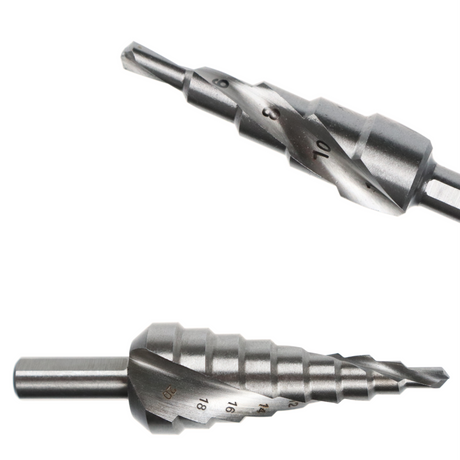
A step drill bit (also known as a cone bit) is a tapered drill bit with multiple diameter steps. A single tool can be used to drill holes of various sizes, enlarge existing holes, and deburr them at the same time. It is primarily designed for thin materials such as sheet metal, pipes, profiles, and plastics.

Which step drill bit is suitable for stainless steel?

For stainless steel (V2A/Inox), an HSSE cobalt step drill bit with a TiAlN coating is the right choice - it is heat-resistant and stable. The working method is important: low speed, even feed rate and good cooling. Spiral point versions cut into stainless steel more easily and with less vibration than straight point versions.

Can you drill into thick solid material with a step drill bit?

No. Step drill bits are designed for thin-walled material such as sheet metal, tubing, and profiles—the wall thickness should be less than the height of the respective step. For thick solid material, use a standard twist drill bit and enlarge the hole in steps if necessary. This keeps the hole round and prevents the step drill bit from being overloaded.

HSS, HSS-TiN or HSSE-TiAlN Cobalt - which is the right one?
Spiral fluted or straight fluted - which is better?

Straight-fluted step drill bits are more affordable and suitable for thin sheet metal, plastic, and wood. Spiral-fluted versions actively clear chips, cut more easily, and run more smoothly—a clear advantage when working with stainless steel, steel, and larger diameters. For clean results in metal, the spiral-fluted version is worth it.

What size or range do I need?

This depends on the hole sizes you frequently need. For electrical and sheet metal work, 4-12, 4-20, or 4-30 mm cover most cases; for large openings, there are versions up to 60 mm. A set with multiple ranges offers the most flexibility. Make sure that the desired size is available as its own step.

How do I drill cleanly and without burrs?

Work at low speed, feed evenly, and cool when drilling metal. Because the step drill bit enlarges the hole gradually, the next step automatically deburrs the hole—simply keep drilling until you have completed the desired step. A backing board and moderate pressure prevent the sheet metal from tearing out.